
When international buyers are on the hunt for a good ratchet crimper supplier, they’ll quickly realize that a shiny, polished catalog isn’t enough. What really counts is consistent force — the kind that you can count on, time after time — along with clean stripping geometry, dependable jaws, and properly documented quality checks. Imagine a loose terminal overheating inside a cramped control cabinet—that tiny flaw could end up shutting down a whole production line, and nobody wants that kind of headache.
In fact, Grand View Research pegged the global hand tools market at around USD 23.7 billion in 2023. They also pointed out that there’s steady demand for ergonomic, task-specific tools. Meanwhile, MarketsandMarkets reports that the growth in electrical testing and connectivity gear isn’t slowing down — spurred by booming industries like automotive, renewables, and industrial automation. All these trends mean that there’s a strong push for reliable crimper ratchet tools, especially ones designed to handle insulated and non-insulated terminals, or even photovoltaic connectors.
Now, quality isn’t just a vague claim — it’s something you can measure. Mike McGlone, a crimping expert from Thomas & Betts, explains, “A reliable crimp starts with the right combination of terminal, conductor, and tool.” That’s a pretty straightforward idea, but in reality, choosing the right supplier can get tricky — your marketing may make it all look easy, but don’t be fooled. Buyers should pay close attention to things like how consistent the crimping force is, how many cycles the tool can handle, calibration records, the materials used in the jaws, warranty details, and how well the samples perform during testing. Sure, a comfy grip helps, but it’s not a substitute for precise, controlled compression.
This guide takes a look at China’s top ten ratchet crimper suppliers for buyers around the world. We consider factors like how much experience they have manufacturing, their ability to ship internationally, certifications, options for customization, quality inspection processes, and after-sales support. Don’t be fooled by product photos that look alike — internal tolerances can differ quite a bit, and that really matters. While rankings can help guide your decision, they’re not the be-all and end-all. For instance, a supplier that’s perfect for solar panel installers might not be the best choice if you’re manufacturing aerospace wiring. Bottom line: thorough testing is still a must before buying large volumes.”
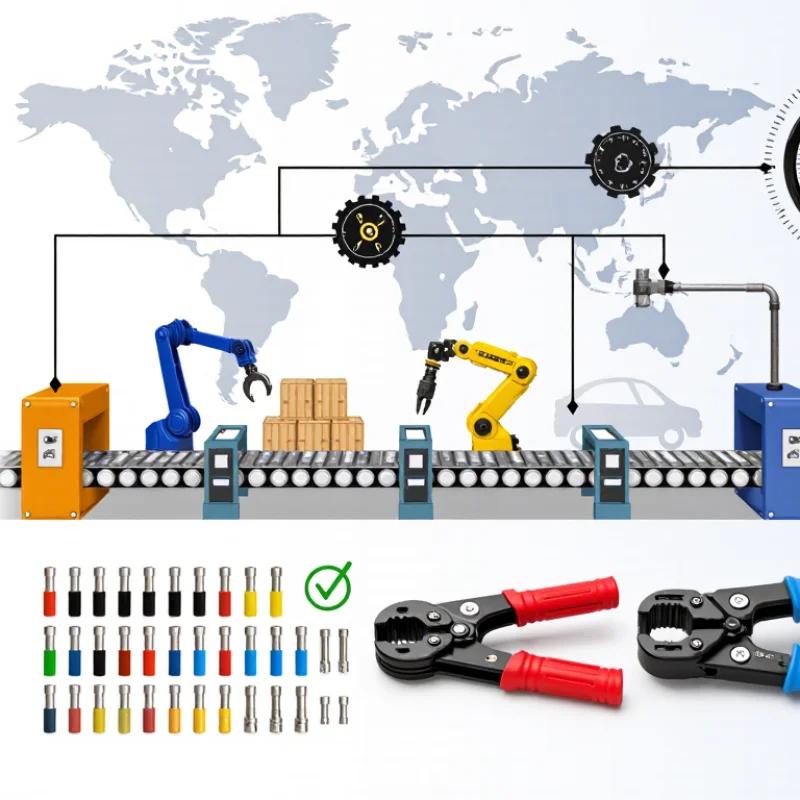
Ratchet Crimper Basics: Mechanisms, Terminal Types, and AWG Compatibility
A ratchet crimper tool uses a toothed cycle to control jaw movement and pressing force. The ratchet prevents the handles from opening before a complete crimp. This helps create consistent connections during repeated assembly work. A full cycle matters.
Different terminals require different die shapes. Insulated terminals usually need color-coded cavities for their sleeve size. Non-insulated terminals often use narrower, more focused crimp profiles. Open-barrel terminals need precision wings that wrap around the conductor and insulation. Closed-barrel terminals may require a separate compression style. A neat-looking crimp can still fail. I have seen loose strands hidden beneath a clean sleeve.
AWG compatibility must match the conductor, terminal, and die marking. For example, a die marked 16–14 AWG is not automatically suitable for every 14 AWG terminal. Copper strand count, insulation thickness, and terminal material can change the result. Always check the terminal manufacturer’s specification and perform a pull test when possible. The chart is not enough.
For global buyers, inspect jaw alignment, ratchet release, handle comfort, and marking clarity. Verify whether the tool supports insulated, non-insulated, or open-barrel terminals. Samples should be tested with the actual wire and terminal combination. My earlier assumption was simple: one tool could cover everything. Practical testing proved otherwise. Temperature, operator strength, and repeated use can also affect crimp quality. Loose dies deserve rejection.
| No. | Crimper Configuration | Ratchet Mechanism | Compatible Terminal Types | Typical Wire Range | Common AWG Compatibility | Insulation Support | Typical Applications |
|---|---|---|---|---|---|---|---|
| 1 | Non-insulated terminal crimper | Full-cycle ratchet with controlled crimp release | Open-barrel copper and brass terminals; closed-barrel lugs | 0.5–6.0 mm² | 20–10 AWG | None; conductor and insulation are crimped separately when required | Automotive harnesses, control panels, and industrial wiring |
| 2 | Insulated terminal crimper | Full-cycle ratchet with color-coded die cavities | Vinyl-, nylon-, and heat-shrink-insulated ring, fork, butt, and female terminals | 0.5–6.0 mm² | 22–10 AWG | Crimps the metal barrel while supporting the insulated sleeve | General electrical maintenance and low-voltage wiring |
| 3 | Open-barrel terminal crimper | Two-stage ratchet for conductor wings and insulation wings | Open-barrel receptacles, tabs, timer terminals, and wire seals | 0.14–2.5 mm² | 26–13 AWG | Usually includes a separate insulation-wing section | Automotive, appliance, and compact wire-harness assembly |
| 4 | Closed-barrel terminal crimper | Indent or hex-profile ratchet mechanism | Closed-end butt splices, cable lugs, and tubular terminals | 1.5–16.0 mm² | 16–5 AWG | Not normally designed for insulated sleeves | Power distribution, battery cables, and industrial control wiring |
| 5 | Heat-shrink terminal crimper | Full-cycle ratchet with insulated-terminal die geometry | Adhesive-lined heat-shrink ring, fork, butt, and spade terminals | 0.5–6.0 mm² | 22–10 AWG | Supports the heat-shrink sleeve without cutting the insulation | Marine, outdoor, automotive, and moisture-exposed connections |
| 6 | Ferrule crimper | Square, hexagonal, or trapezoidal multi-profile ratchet | Bootlace ferrules and twin-wire ferrules | 0.25–16.0 mm² | 24–5 AWG | Crimps the metal ferrule; the plastic collar remains outside the die | Terminal blocks, circuit breakers, and control cabinets |
| 7 | Coaxial cable crimper | Full-cycle ratchet with interchangeable compression or hex dies | F-type, BNC, TNC, and other coaxial cable connectors | Typically 3.6–10.3 mm cable diameter | AWG depends on cable construction; commonly 18–10 AWG center conductors | Supports the connector ferrule and cable jacket | RF, CCTV, broadcast, antenna, and telecommunications installation |
| 8 | Modular plug crimper | Ratchet press with connector-positioning cavity | RJ11, RJ12, RJ45, and compatible modular plugs | Commonly 24–26 AWG twisted-pair conductors | 24–26 AWG for many data cables | Terminates plug contacts and may include strain-relief support | Telephone, Ethernet, and structured cabling work |
| 9 | Ignition-terminal crimper | Dedicated ratchet with conductor and insulation crimp sections | Non-insulated ignition, distributor, and spark-plug wire terminals | Approximately 0.5–2.5 mm² | 20–13 AWG | Designed for terminal wings and ignition-wire insulation | Automotive ignition harnesses and engine electrical repairs |
| 10 | Heavy-duty cable-lug crimper | High-leverage full-cycle ratchet with hex or indent dies | Large copper and aluminum lugs, battery terminals, and splice sleeves | 10–50 mm² | 8–1/0 AWG | Generally intended for uninsulated heavy-gauge terminals | Battery systems, renewable energy, telecom power, and industrial equipment |
Note: AWG ranges are typical compatibility guidelines. The exact range depends on the die profile, terminal material, conductor class, and the supplier’s stated specifications. Always verify the terminal and wire combination before production use.
China’s Top 10 Suppliers: Ranking Scope, Product Categories, and Export Reach
This ranking examines China’s top 10 Ratchet Crimper suppliers through practical buyer criteria. The scope covers manufacturers and export-oriented trading companies with consistent product documentation. Evaluation includes production experience, crimping accuracy, tool materials, quality controls, and overseas service. Product categories include insulated terminal crimpers, non-insulated terminal tools, wire-end ferrule crimpers, and modular die systems.
Export reach also matters. Suppliers serving Asia, Europe, North America, and the Middle East usually understand packaging, labeling, and shipping paperwork better. Some provide samples, replacement dies, calibration guidance, and private packaging. A useful check is simple: request a sample, inspect the ratchet release, and test several wire sizes. The handle should close smoothly, without excessive side movement. Carton strength matters too, especially during long sea transport.
This ranking is a buyer’s screening tool, not a permanent judgment. Public information can be incomplete, and factory capacity may change during peak seasons. A supplier may show strong export records but offer limited technical support. Another may produce excellent tools yet lack fast delivery. That difference is easy to miss. Buyers should verify test reports, production photos, lead times, warranty terms, and actual shipping records before placing large orders. Supplier rankings need regular review.
China Ratchet Crimper Supplier Review: Scope and Export Readiness
A 10-point buyer checklist for comparing suppliers without presenting unverified company rankings or market-share figures.
| Category | Checklist Items |
|---|---|
| Product Categories | 4 |
| Product Validation | 3 |
| Export Readiness | 3 |
The bars count checklist items, not suppliers or sales. Product categories cover ferrule, insulated-terminal, non-insulated-terminal, and open-barrel crimpers. Product validation covers wire-size range, die compatibility, and ratchet function; export readiness covers destination coverage, compliance documentation, and shipping preparation. Confirm each point directly with suppliers.
Supplier Evaluation Metrics: ISO 9001, IEC 60352-2, UL 486A-486B, and CE
China Top 10 Ratchet Crimper Suppliers for Global Buyers
When evaluating Chinese ratchet crimper suppliers, certification evidence should come before catalog claims. The ISO Survey 2022 recorded more than 1.2 million ISO 9001 certificates worldwide. This figure shows its broad adoption, but not automatic product quality. Ask for the current certificate, certified site address, scope, and latest audit status. A factory producing pliers may not be covered by the stated scope.
IEC 60352-2 provides useful guidance for solderless connections, including crimped terminations. Request test records showing conductor size, pull-out force, crimp height, and cross-section results. UL 486A-486B requirements also help assess terminals, connectors, and wire connection safety. The tool itself still needs verification. Check ratchet release, die hardness, cycle testing, and calibration control. Small details matter.
CE should be reviewed differently. It is a conformity declaration for applicable European requirements, not a universal quality certificate. Suppliers should identify relevant directives, keep technical files, and provide a signed Declaration of Conformity. The EU Safety Gate Report 2023 recorded over 3,400 dangerous product alerts, reminding buyers that paperwork can fail in practice. I have seen impressive certificates paired with weak sampling records. That is uncomfortable, but realistic. Independent pre-shipment testing remains valuable. Ask for traceable samples, not only scanned documents.
Crimping Performance Data: Force Range, Wire Size, Cycle Life, and Accuracy
For global buyers comparing China’s top ratchet crimper suppliers, performance data matters more than catalog claims. IEC 60352-2 defines test methods for crimped connections, while IPC/WHMA-A-620D provides workmanship criteria for wire preparation, compression, and inspection. A credible Pro Series Ratchet Crimper should publish measured force ranges, not vague terms like “heavy duty.” Typical hand tools generate roughly 1,500 to 3,500 newtons at the terminal, depending on geometry and wire size. The useful range often covers 0.5 to 6 mm² conductors.
Wire compatibility must be verified by actual terminal testing. Copper conductors can deform differently from plated or finer-stranded wires. Independent quality records should show pull-force results, crimp-height measurements, and sample quantities. For cycle life, professional evaluations commonly test 10,000 to 20,000 ratchet operations, recording release failures, jaw wear, and force drift. Accuracy deserves equal attention. A practical target is crimp-height variation within ±0.05 mm under controlled conditions. Small errors become visible near the terminal barrel.
The weak point is often testing consistency. Humidity, operator grip, and terminal tolerance can change results. Buyers should request raw test tables, calibration dates, and failed-sample photographs. A supplier that reports only its best reading leaves too much unanswered. Data should be repeatable.
Global Buyer Comparison: OEM Capacity, MOQ, Lead Time, Warranty, and Pricing
China’s ratchet crimper supply base suits buyers who compare more than catalog prices. Grand View Research valued the global hand tools market at about USD 23 billion in 2023, with steady growth expected through 2030. That demand encourages factories to offer OEM molds, laser markings, color boxes, and private manuals.
For OEM projects, typical MOQs range from 100 to 500 pieces. Simple logo changes may need less. New handle molds usually require higher volumes. Standard production often takes 25–45 days after sample approval. Rush orders are possible, but quality checks may suffer. A practical warranty benchmark is 12–24 months, covering ratchet failure and jaw alignment. Ask for written exclusions.
Pricing varies sharply. Basic insulated models may quote around USD 4–8 FOB, while heavier tools with hardened jaws and custom packaging can reach USD 12–18. These figures are working benchmarks, not fixed market prices. Freight, tooling, testing, and packaging can change the final landed cost. The International Trade Centre’s trade data also shows how freight and tariff structures affect tool sourcing decisions across markets. Get three comparable quotations.
Supplier evaluation should include sample compression tests, cycle testing, material certificates, and photographs of production records. A factory may promise 30-day delivery, yet component shortages can extend it. This is where buyer experience matters. I would score response speed, defect handling, and documentation, not just the lowest quote. Mistakes happen. Weak follow-up costs more than a slightly higher unit price.
Compliance and Sourcing Risks: Testing Records, Tool Traceability, and After-Sales Support
When evaluating a Self-Adjusting Ratchet Crimper, buyers should inspect evidence, not polished catalog photos. Each production batch should include crimp-height records, pull-force results, and gauge verification. The records need batch numbers, test dates, operators, and equipment IDs. A missing signature can weaken confidence.
IPC/WHMA-A-620 provides widely used workmanship criteria for cable and wire-harness assemblies. It does not replace tool-specific validation. Ask suppliers for test methods, sample sizes, acceptance limits, and calibration certificates. Deloitte’s 2023 Global Chief Procurement Officer Survey reported that 79% of procurement leaders faced significant supply-chain disruption. Traceability reduces the impact of unclear replacement parts and inconsistent production lots.
After-sales support deserves practical testing. Can the supplier identify a failed tool from one serial number? Can they provide replacement dies, spring kits, and repair instructions? Response-time commitments should appear in writing. Keep this evidence.
A factory may promise “100% inspection.” That phrase proves little without records. I have seen neat spreadsheets with no link to physical samples. Buyers should request three recent anonymized reports and compare dates, lot codes, and measured values. Sometimes the uncomfortable answer is no. That is still useful before a large order.
China SO-30J Ratchet Crimping Tools: Features, Benefits, and Choosing a Reliable Supplier
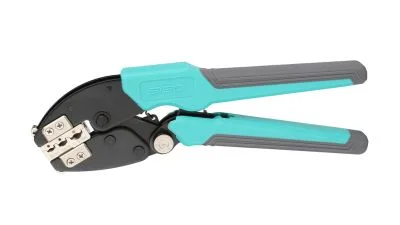
The China SO-30J ratchet crimping tool is designed for reliable electrical work, cable assembly, maintenance, and installation. It supports wires from 0.5 to 6 mm², covering approximately AWG 22 to 10. Its precision die is suitable for insulated terminals, including insulated spade connectors, helping create secure and consistent crimps without damaging the wire or terminal. The ratchet mechanism maintains steady pressure throughout each operation and releases only after the crimp is properly completed.
A durable construction and ergonomic handle make the tool comfortable for repeated use, whether in a workshop, on a job site, or during routine equipment maintenance. When choosing a reliable supplier, buyers should consider material quality, production consistency, inspection procedures, and after-sales communication. A dependable Chinese factory can provide stable manufacturing capacity, carefully tested tools, and practical support for different purchasing requirements. This crimping solution is a valuable addition to any electrical toolkit, offering efficient performance for common insulated-terminal applications.
FAQS
What does a ratchet crimper do?
It controls jaw movement through a toothed cycle. The handles stay locked until the crimp finishes. A full cycle matters.
Why do different terminals need different crimping dies?
Insulated terminals need cavities matched to sleeve colors and sizes. Open-barrel terminals need wings that wrap around the wire. Closed-barrel terminals may need compression dies. One die rarely handles everything well.
Does a clean-looking crimp guarantee a reliable connection?
No. Loose strands can hide beneath a smooth sleeve. Inspect conductor placement and perform a gentle pull test when possible.
How should AWG compatibility be checked?
Match the wire, terminal, and die marking. A 16–14 AWG marking may not suit every 14 AWG terminal. Check strand count, insulation thickness, and terminal material.
What performance information should buyers request?
Request force ranges, pull-force results, crimp-height measurements, and tested sample quantities. Raw tables are more useful than “heavy duty” claims. Best-case data is not enough.
What force and wire sizes are common for professional hand crimpers?
Many hand tools produce about 1,500 to 3,500 newtons at the terminal. Common coverage ranges from 0.5 to 6 mm² conductors. Actual testing remains necessary.
How can cycle life and accuracy be evaluated?
Professional testing often checks 10,000 to 20,000 ratchet operations. Inspect release failures, jaw wear, and force changes. A practical crimp-height target is within ±0.05 mm under controlled conditions.
What should global buyers inspect before ordering?
Check jaw alignment, ratchet release, handle movement, markings, packaging, lead time, and warranty terms. Test samples with the exact wire and terminal combination. I once assumed one tool could cover everything. Testing changed that view.
Conclusion
This guide presents a practical overview of China’s leading Ratchet Crimper suppliers for global buyers, covering tool mechanisms, terminal types, wire gauges, and AWG compatibility. It explains how ratchet systems support consistent compression and compares key performance indicators, including crimping force, usable wire range, cycle life, dimensional accuracy, and suitability for different electrical applications. The ranking framework considers product categories, manufacturing capability, export experience, and support for customized or OEM projects.
For purchasing decisions, the article outlines important evaluation factors such as ISO 9001, IEC 60352-2, UL 486A-486B, and CE-related documentation, while emphasizing that buyers should verify current test records and product applicability. It also compares MOQ, lead time, pricing, warranty terms, and after-sales service. Special attention is given to sourcing risks, including incomplete traceability, inconsistent quality control, unclear inspection procedures, and insufficient technical support. This framework helps buyers select reliable suppliers with transparent performance data and stronger long-term cooperation potential.